The World Cup Needs to Respect And Protect Local Communities
Soccer is called “the world’s game” because it is truly global and belongs to everyone: the kids playing barefoot in the park, the fans in the cheap seats, the communities that turn every match into a block party.
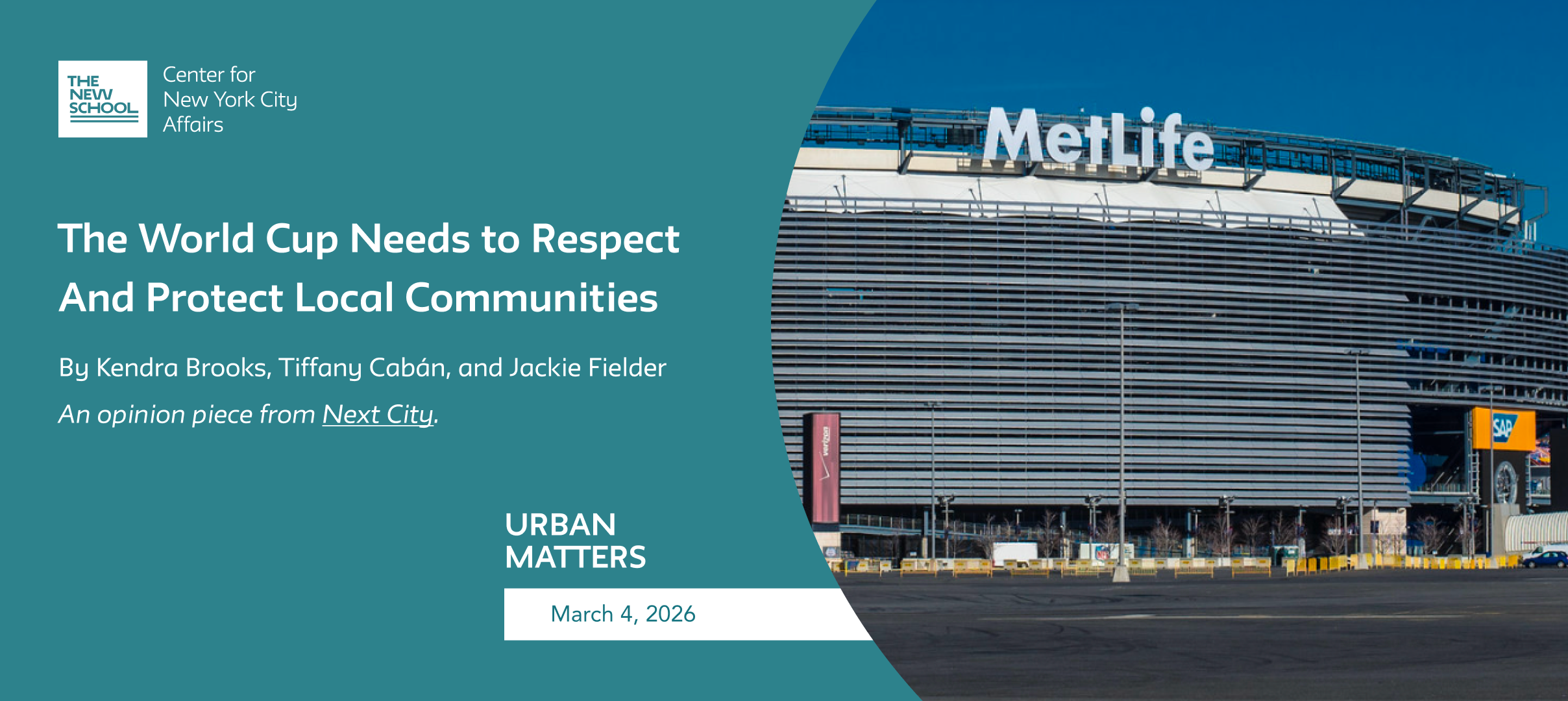
This year, the FIFA Men’s World Cup will bring that game to our own cities: Atlanta, Boston, Dallas, Houston, Kansas City, Los Angeles, Miami, New York-New Jersey (at the MetLife Stadium, pictured above), Philadelphia, San Francisco, and Seattle. This is a moment that should unite us with pride and joy, but too often, the institutions and unaccountable elites behind the sport build walls where there should be open fields.
When the World Cup comes to town, the people who make our cities what they are can find themselves pushed to the sidelines: displaced, surveilled, and shut out of decisions made behind closed doors. As local elected officials, we want to welcome the world — but not at the expense of our backyard, our planet, our workers, our finite budgets, or our neighbors who live here.
We have a responsibility to ensure FIFA doesn’t treat our cities as their playground. We demand real protections for our community around housing, immigrant rights, and affordability, ahead of the World Cup.
Given FIFA’s history of human rights abuses, our localities are the last credible line of defense to protect communities before, during, and after the games. FIFA’s record, from worker exploitation and discrimination in Qatar to entrenched corruption, show us what’s at stake. The 2025 Club World Cup offered a preview of the risks ahead, surfacing 145 human rights concerns tied to immigration enforcement, federal law enforcement presence, and extreme heat.
Similarly, while the White House has made public reassurances that fans and athletes will be safe during the World Cup, those promises ring hollow while our cities are currently under attack from the federal government. Over the past year, despite FIFA’s bestowal of a “peace prize” to President Trump, we’ve seen crackdowns around immigration and free speech, the gutting of labor protections, and massive federal cuts to affordable housing and renewable energy programs.
Gone unchecked, these games could intensify this devastation by ballooning surveillance systems, spiking the detainment of immigrants, accelerating displacement, hollowing out our available housing, stoking gentrification, exploiting workers, escalating the climate crisis, and locking out the very people who live here from enjoying the games.
Cities have the opportunity to hold FIFA accountable to their commitments through the implementation of human rights action plans. FIFA pledged to have each host city committee develop these plans to illustrate how human rights will be protected at the World Cup, but development has been inconsistent and hidden from the public, due to FIFA’s own demands, secrecy, and outsized power.
With just a few months left until the games start, it’s alarming that only a few committees have made their human rights plans public. A compressed, rushed timeline makes a mockery of these human rights commitments, making it clear that they are for little more than show.
And let’s be clear: FIFA built the conditions for these harms by trying to shift the spotlight to host committees and escape scrutiny. With the global power they command, FIFA should be held to account and they should be the ones pressing the administration when human rights are at risk.
We’re proud to host the games, but we cannot abide secrecy, fast-tracking, and non-binding commitments. Every city has the responsibility to ensure human rights protections for its people, and every resident has the right to shape what happens to the places where they live.
The only way to protect our communities is to give real power to the people and organizations who will actually live with the consequences of the games: unions, tenants, community-based organizations, and everyday residents. They bring expertise, networks, and on-the-ground experience that can turn lofty aspirations into real protections.
Until the human rights action plans are made public and grassroots groups are invited in by FIFA as sincere collaborators, the people most affected by the World Cup remain locked out of their own story.
As local elected officials from three different host municipalities, we demand transparency and accountability from FIFA. That means making human rights plans public, committing to deep, ongoing collaboration with local groups, and using FIFA’s leverage to make human rights demands of President Trump - rather than rewarding him.
Hosting one of the world’s biggest sporting events is an immense honor, but it cannot come at the expense of our neighbors. The 2026 tournament will unfold under the gaze of the world. It’s not just a test of our hospitality; it’s a test of our democracy, values and commitment to justice at home.
Grassroots organizers are ready to meet host committees and FIFA at the table — not as accessories, but as the only people with the legitimacy to force real protections into place. A World Cup that lives up to its name belongs to everyone, not a wealthy few.
Kendra Brooks is the Minority Leader of the Philadelphia City Council. Tiffany Cabán is a New York City Council member and chair of the Council Committee on Mental Health and Addiction. Jackie Fielder is a member of the San Francisco Board of Supervisors. All three are members of Local Progress, a national coalition of local elected leaders committed to justice and equity.
This piece was originally published on Feb. 9, 2026 by Next City, a nonprofit newsroom reporting on solutions for equitable and just cities, and appears here with their permission.
Photo by: mhfernandez