Mamdani Calls the Property Tax System ‘Broken.’ He’s Right. Here’s How It Might Be Repaired.
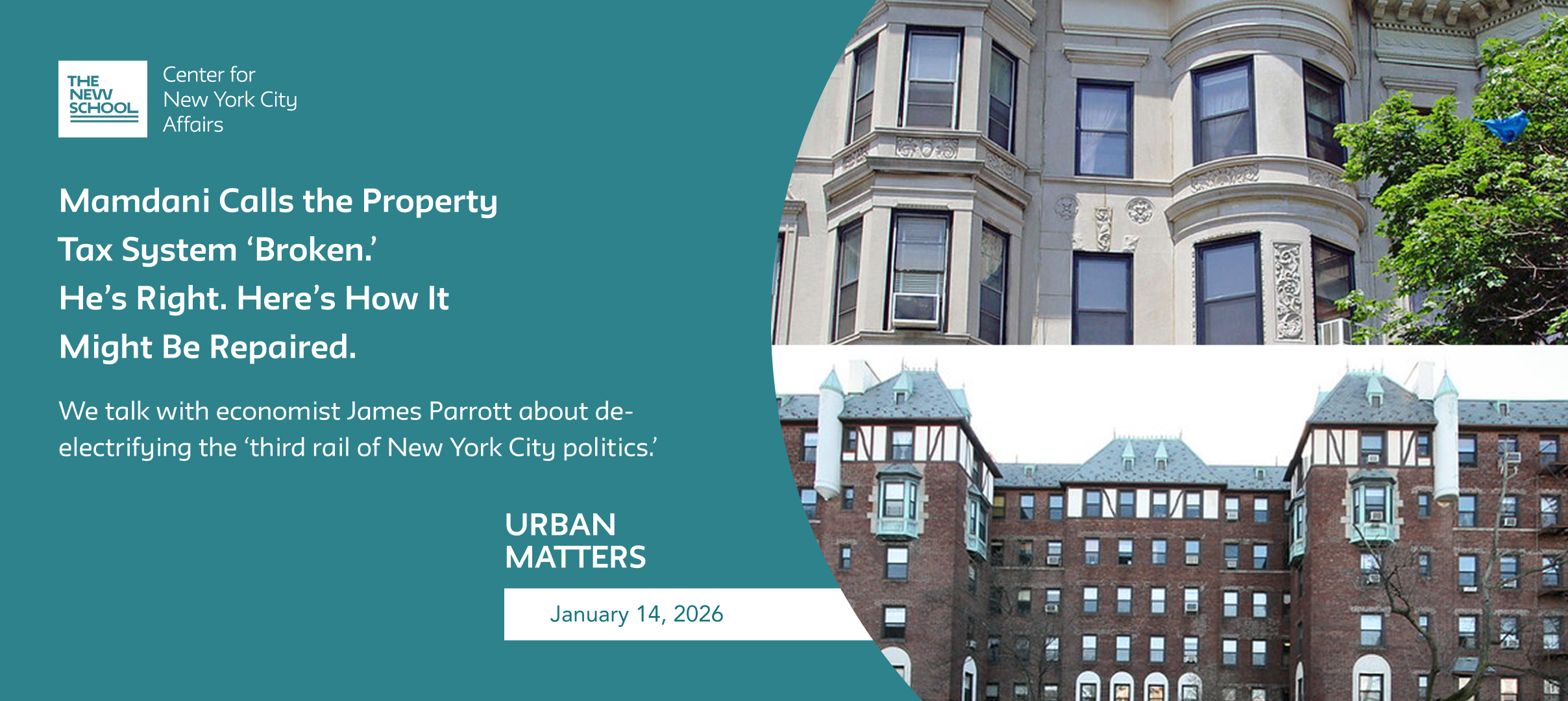
Urban Matters: James, early in his inaugural address, Mayor Zohran Mamdani pledged to fix ‘a long-broken property tax system.’ As a call to arms, that lacks the popular oomph of ‘Freeze the Rent’ or “Free Child Care’ – the issues he ran on. After all, two-thirds of New Yorkers are tenants. Most can’t imagine ever owning property here. So why did he give it such prominence? Why is it a big deal?
James Parrott: New York City will raise over $35 billion this year through the real property tax. It’s by far the single largest tax the City has, accounting for 43 percent of all tax collections. It’s also considered the third rail of New York City politics. Reforming it will create ‘winners’ and ‘losers,’ and even though the winners would likely outnumber the losers, many losers will lose big, because they have benefitted from the system’s inequities for so long. The system’s dysfunction is glaring, so if you want to restore confidence in government, you have no choice but to take this on. I think one reason Mamdani has prioritized this issue is that he is intent on demonstrating that government can work more effectively and make things better for the average person if it doesn’t balk at taking on big problems.
UM: So, it seems you agree that our property tax system is broken. How and why is that true?
Parrott: The property tax system has been a mess for the past four decades, and in multiple ways. It is fraught with inequities and the source of justifiably loud complaints from many residential owners who are over-paying compared to wealthier co-op, condo, and home owners in high-income Manhattan neighborhoods or brownstone Brooklyn.
The major problems are rooted in a 1981 State law passed at a time of great concern about stemming the flight of the city’s middle class to the suburbs. Among its complications, three stand out.
The first is that one-, two-, and three-family homes have a low six percent assessment ratio relative to market value; other residential property types have a 45 percent assessment ratio. The second is that co-ops and condos are valued as if they were rental properties. Together, these two features result in lower effective property taxes – taxes as a percent of comparable sales market value – for owner-occupied homes and apartments compared to rental apartment buildings.
The third and most reviled feature of the status quo is that the growth in assessments for one-, two-, and three-family homes is capped at six percent a year, or a cumulative 20 percent over five years. That has resulted in extremely wide variation in effective property taxes on a neighborhood basis, with ones that have experienced the greatest sales price increases over the past four decades having the lowest effective tax rates. This means, for example, that many homes in brownstone Brooklyn have much lower effective tax rates than homes in many middle- and moderate-income neighborhoods, such as Bay Ridge or those on Staten Island.
UM: So, if we want property taxes to be fairer and simpler, where and how should we start?
Parrott: I was a member of an eight-person Advisory Commission on Property Tax Reform appointed by Mayor Bill de Blasio and Council Speaker Corey Johnson. We issued a final report at the end of 2021. We recommended stripping out features that led to structural inequities and providing relief mechanisms and protections to help ensure low- and moderate-income owners have affordable tax bills and that primary residents are not displaced from their neighborhoods.
Specifically, we recommended eliminating the assessment caps and equalizing taxation of resident-owned properties, by assessing all one-, two-, and three-family homes, and also co-ops and condos, based on full market value rather than some fraction of market value.
A partial ‘homestead exemption’ would lower the tax burdens on properties that are primary residences of the owners. The homestead exemption would have a $500,000 annual eligibility income cap for the homeowners. We also proposed a ‘circuit breaker’ feature that would set a limit on property tax liability on owner-occupied homes for low- and moderate-income residents. The new tax structure would be phased in, to restrain tax increases for owners who’ve benefited from the current assessment caps or the rental equivalence method of taxing co-ops and condos.
Since the homestead exemption would exclude absentee owners of high-value ‘pied-a-terre’ properties, they would pay much higher effective taxes than they now do.
In short, we sought to address what we called ‘horizontal inequities’ by equalizing property tax rates, while also – with the circuit breaker and partial homestead exemptions – promoting ‘vertical equity’ by lessening the regressivity of property taxes relative to income.
Let me add two other points that I imagine could be part of Mamdani’s property tax agenda.
The first relates to the fact that rental buildings generally pay higher effective property taxes than one-, two-, or three-family homes. Much of the resulting costs are then passed on to the tenants. So, an affordability agenda should address how to reduce that tax inequity and ensure that both tenants and truly struggling small landlords benefit – while also figuring out how to make up any revenues lost as a result.
Second, our commission noted that some very wealthy private institutions in the city, including big private universities and private hospital systems, benefit from the State Constitution’s ‘charitable institution’ tax exemption. It saves them an estimated $3.2 billion a year in property taxes. The Commission discussed the idea of a ‘public safety fee’ for all property owners that would help pay for the public services they receive; the fee would then be reduced by the amount of property taxes the owners pay.
UM: Final question: As a group, a lot of middle-class, outer borough homeowners didn’t vote for Mamdani for mayor. So, should talk about overhauling the property tax system worry them? Would their tax bills go up?
Parrott: Actually, in many of those outer borough neighborhoods most homeowners likely will come out ahead. And since we’re now talking politics, let me add this. I’ve always thought that property tax reform was such a third rail issue it could only be achieved in the second term of a term-limited mayor – someone not concerned with re-election. That is, until Mamdani came along. If he can succeed where his predecessors have failed, that will add to the reputation he hopes to establish that making government work is key to restoring faith in democracy.
James Parrott, a senior advisor and fellow at the Center for New York City Affairs at The New School, served on New York City’s Advisory Commission on Property Tax Reform.
Photos by: Dan Beards and Michael Parman