
Their Finest Hour: How St. Vincent’s Hospital Met the AIDS Crisis
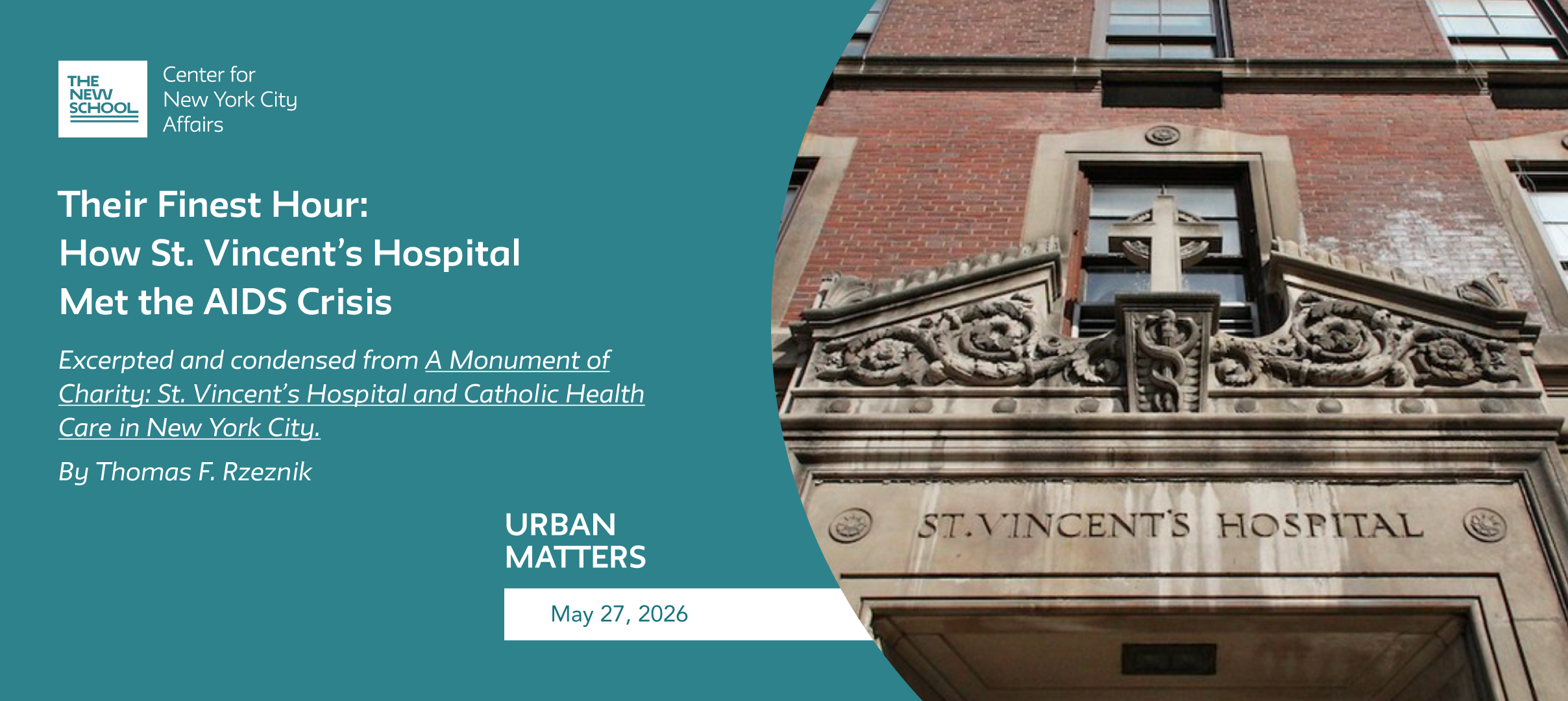
Buried within St. Vincent’s 1981 annual report was a brief mention of work by the microbiology department to determine the cause of the new “homosexual disease” that was becoming a “serious community health problem” in New York City, especially in and around Greenwich Village. [Founded in Greenwich Village in 1849 by the Sisters of Charity, St. Vincent’s Hospital operated there until its closing in 2010.]
Few could have predicted those handful of cases would soon give rise to a harrowing epidemic claiming countless lives and shaping a generation. Among the city’s major medical centers, none witnessed the devastation more acutely than St. Vincent’s, whose very name became synonymous with AIDS care.
With little that could be done medically, the disease was generally regarded as a death sentence. Young men who only months earlier had been in the prime of their lives languished in hospital beds, lacking the strength to care for themselves. Many bore the disfiguring marks of Kaposi’s sarcoma, a rare cancer that emerged as a tell-tale sign of the disease.
Even though St. Vincent’s could not have prepared for the onslaught of AIDS, its response drew upon its longstanding strengths: the quality of its nursing care, its commitment to serving the poor and marginalized, and its concern for the spiritual well-being of its patients. With medical science stymied, these aspects of care gained renewed saliency.
Among those who shaped St. Vincent’s response, none was more influential than Sister Patrice Murphy, the founder of the hospital’s hospice program. As the number of patients with AIDS began to swell, she refocused the program to respond to their unique needs. She recalled how her commitment to caring for the dying was shaped by the wakes and funerals that marked her Irish Catholic upbringing and the sense that “death itself is a part of life.”
For Sister Patrice, hospice embodied “a philosophy of caring.” It focused on “living rather than dying” and sought to convey to the terminally ill that “you matter because you are you. You matter until the last moment of your life, and I will do anything possible to help you live fully.”
As the AIDS crisis began to unleash its toll, “it seemed only right and just that the Hospice staff extend its expertise – the fruit of its experiences with so many other suffering people – to this group of afflicted persons,” she said. Yet nothing could prepare them for the tragedy they witnessed: not just the physical decline of so many young men but the unique emotional and psychological anguish they experienced. Many were alienated from families and abandoned by friends. Others had lost jobs or faced eviction when their status became known. They had become modern-day lepers, deprived of human contact and care. Many spoke of how they longed for the simplest signs of human recognition, like the feel of another’s touch.
Adding to the challenges was the issue of homosexuality. Would a Catholic institution be welcoming to gays? Would patients be forced to deny or hide their sexuality? Would they be scorned for their perceived sins? Some persons with AIDS intentionally avoided St. Vincent’s, fearing they would face religious prejudice or moral reproach.
Sister Patrice understood the realities all too well. As though anticipating charges made later, she flatly declared that “judgment doesn’t enter into our work at all.” She instructed volunteers that they were to serve as caregivers and healers, “not as moralists.”
At a time of deep division between the gay community and the church, this spirit of acceptance sent a powerful message to those under the hospital’s care, many of whom were gay Catholics. For those whose faith in the church, and even in God, had been shattered, the unconditional embrace they encountered provided an affirmation of their status and moral worth. By reaching out to patients’ partners and including them in bereavement groups and other programs, the Supportive Care Program recognized the strength and integrity of same-sex relationships, and the love that existed within them.
For those working within the hospital, these experiences and encounters could be equally transformative. To minister to those with AIDS was to come to know them and care for them for who they were.
The hospital’s response was not without faults, especially in the early years. Some who came to visit friends and loved ones were shocked to find hallways lined with patients on gurneys waiting for admission. Others criticized the hospital for housing the AIDS ward in one of the oldest parts of the complex, where beds were packed into small, cramped rooms.
St. Vincent’s also had to contend with tensions over church teachings over condom use and safe-sex guidelines. Hospital officials worked to balance respect for the church’s teachings that forbade artificial contraception and the pressing need to combat the spread of the disease. Hospital officials turned a blind eye to doctors and staff members who distributed condoms in violation of hospital rules. But there were lines that had to be drawn. In 1989, the administration’s decision not to approve a study into the efficacy of postexposure prophylaxis for those who had engaged in unprotected sex contributed to the departure of the head of the hospital’s AIDS Center.
Whatever the hospital’s shortcomings, there was no denying the dedication exhibited at St. Vincent’s, whether in the AIDS ward or elsewhere. The AIDS crisis left an indelible mark on the hospital and all who worked there. Abstract principles became embodied in daily labors. Love and charity were lived out. When others turned their backs on the afflicted, they embraced the sick and the suffering, offering compassionate, loving, and indiscriminate care. They helped shape the language surrounding the disease, eschewing blame and stigma and focusing instead on providing care and affirming the inherent worth and dignity of every person.
Thomas F. Rzeznik is a professor of history at Seton Hall University and the author of A Monument of Charity: St. Vincent’s Hospital and Catholic Health Care in New York City, newly published by New York University Press. This excerpt appears with the permission of the author and publisher.
Photo credit: Ricky Leong