
In Fixing Our Housing Crisis, One Size Just Won’t Fit All.
America is stuck.
Millions of American households struggle with rising rents, aging homes, and shrinking affordability. Experts on both sides of the aisle recognize the root causes of the current crisis, including decades of underbuilding and inconsistent local regulation.
Often the proposed solutions might sound appealing – whether it’s President Trump’s push to restrict single-family home sales or introduce half-century mortgages, or proposals like Ezra Klein’s to blanket lift restrictions on building affordable housing. But under the surface, these top-down, one-size-fits-all ideas oversimplify the complex housing problem we are facing across the country.
In December, a more thoughtful approach — the broadly supported, bipartisan ROAD to Housing Act — was stalled by Congressional leadership. Recently, bipartisan leaders in the House introduced the Housing for the 21st Century Act, another version of this legislation that they hope to push through this month.
American families cannot wait any longer for action. As Washington dithers, for many families the dream of owning or renting a stable, safe home is slipping further away. The responsibility to deliver solutions will increasingly fall to states, cities, and communities – and the next phase of America’s housing strategy must rely on local initiative and bold state-level leadership.
Housing may be financed nationally, but it is lived locally. The United States does not have one housing market, it has thousands. And while we need more homes, what we need most is housing precision, the ability to match what we build and where we build it to the people and communities who will live there.
A recent World Economic Forum analysis argues that many countries are not facing a true shortage but a housing mismatch, with units built in the wrong places or at prices that do not fit the people who need them. That’s why the first question in any housing plan should not be “How do we build more?” but “What does this neighborhood need?” In some places, more density is the right answer. In others, repairing and preserving existing homes is far more urgent.
An older East Coast city with prewar buildings and aging infrastructure has little in common with a fast-growing Sunbelt metro. Rural communities with limited construction labor and low property values face barriers that zoning reform alone cannot fix. Even within a single city, neighborhoods only blocks apart can have entirely different needs.
Expanding supply in these communities requires restoration, reuse, and retrofitting, not simply new units. New Orleans has developed an innovative tool to do just this: Its Market Value Analysis assesses how conditions and needs differ block by block, and has driven far more nuanced and effective housing investments.
Communities should be at the center of the housing agenda – and it’s up to federal policymakers to equip them properly. A neighborhood with many fixed-income seniors requires a different mix of homes than one anchored by service sector workers or one near a university. When we build without considering who will live there and what they can afford over time, we risk vacancy on one side and displacement on the other.
States and local jurisdictions should make the most affordable homes available to homebuyers first, before corporate investors can compete for the same limited inventory. States and cities should offer targeted repair and retrofit incentives so new homeowners can look at older homes, and are not priced out of necessary fixes from the start.
Housing innovation also has to meet local realities. Modular and factory-built homes like Atlanta’s Melody project can cut costs in areas with labor shortages. 3D-printed homes may be better suited for regions with severe weather and high construction expenses. Older cities like San Francisco and New York may need retrofits and adaptive reuse, while many Midwestern and rural communities benefit more from restoring vacant or abandoned homes than building new ones.
Finally, affordability is shaped by much more than rent or mortgage costs – from rising insurance premiums and property taxes, to skyrocketing costs for utilities, transportation, health care, and child care that price families out of housing.
Federal action is essential but cannot succeed on its own. State and local governments must lead the way, with federal support. Washington can supply capital, modernize financing, and create incentives for better local decision making —- but local governments must anchor that direction in the realities of their neighborhoods.
Supporting communities is the key. Local governments have been asked repeatedly to modernize zoning, approve more density, speed up permitting, and preserve aging stock; but planning departments operate with thin budgets, limited staff, outdated technology, and insufficient data. Too often we ask communities to pursue broad goals without tools or support that reflect their actual operational conditions.
A national housing push is necessary, but a national template will not work. Solving housing affordability requires federal ambition and local policy precision.
Alanna McCargo is the senior fellow for inclusive capitalism at the Clinton Foundation. She previously served as president of Ginnie Mae and as senior housing finance adviser to the secretary of Housing and Urban Development in the Biden administration. Laurel Blatchford is director and senior partner at Delivery Associates, a global social impact consultancy. She has held leadership roles at the US Department of the Treasury, US Department of Housing and Urban Development, and in the administration of New York City Mayor Michael Bloomberg.
This piece was originally published on Feb. 4 by Next City, a nonprofit newsroom reporting on solutions for equitable and just cities, and appears here with their permission.
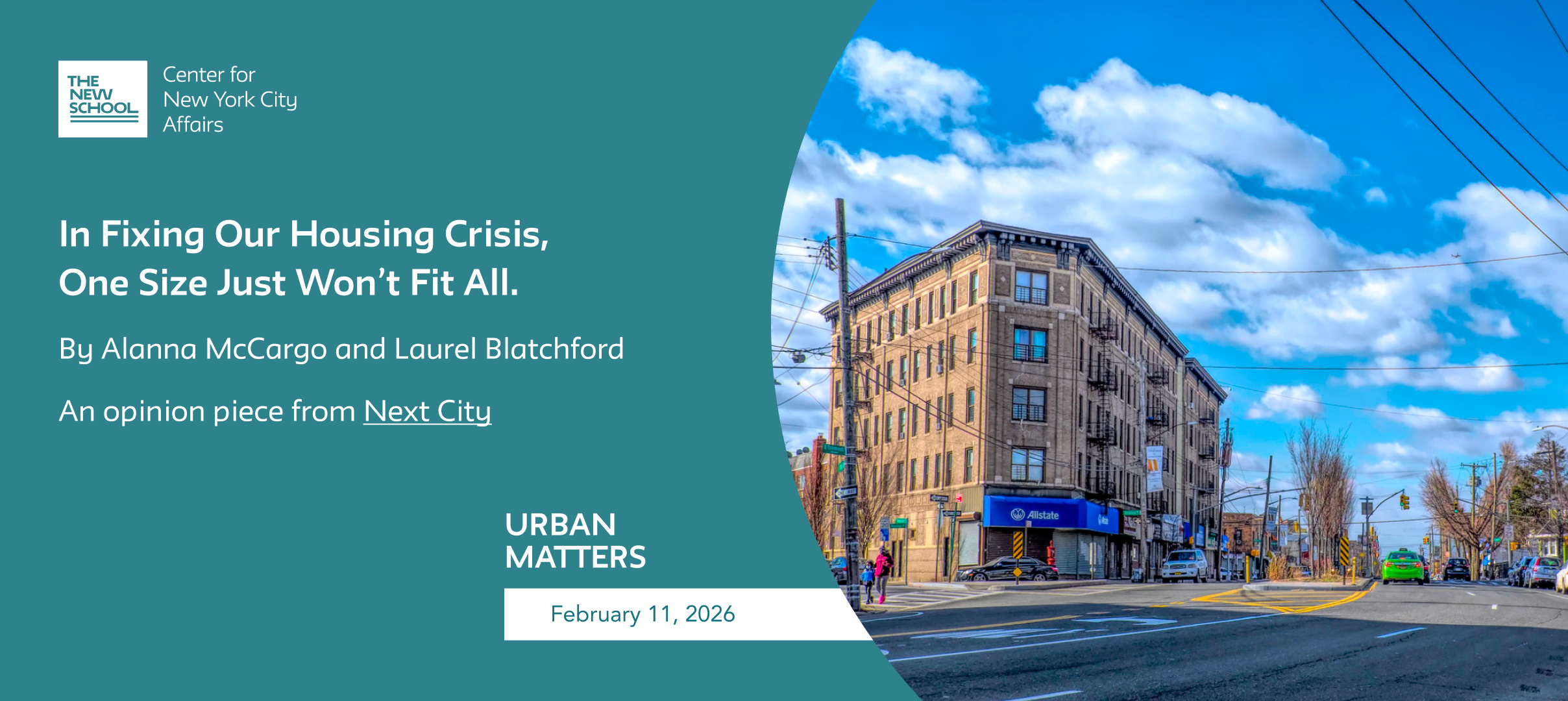
Photo by: June Marie