
How Mamdani Can Take A First Step Toward Universal Child Care
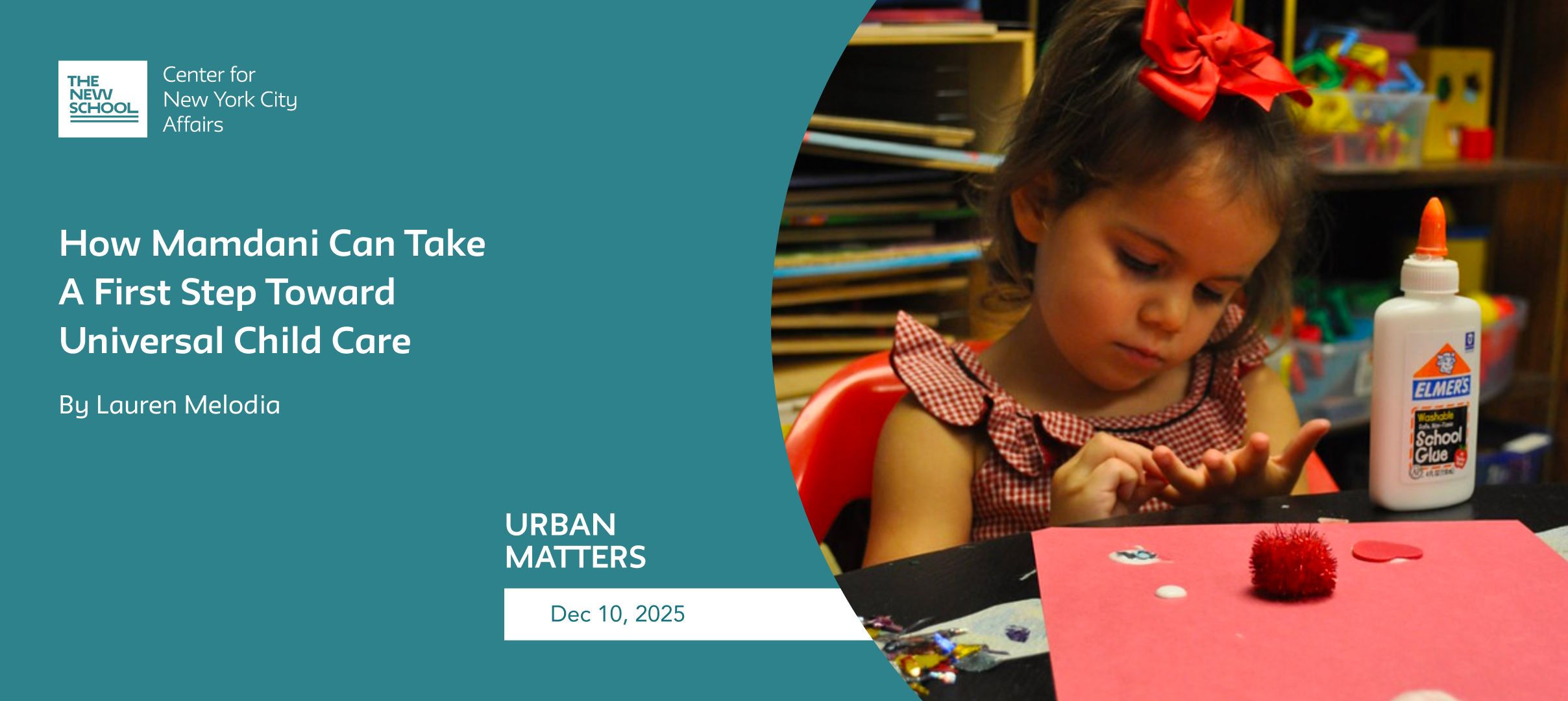
Mayor-elect Zohran Mamdani now faces the challenge of turning his pledge to provide universal child care into a reality. At the outset, it’s vital to understand why that promise of universality is politically crucial. From the New Deal to the present, history shows that universal social programs such as Social Security and Medicare are less likely to face subsequent cuts or elimination precisely because they benefit everyone, including wealthy and politically connected people.
While instituting universal child care will likely be a step-by-step process, it’s also important to show immediate progress. And there’s a simple, low-cost first step Mamdani can take in that direction right away. It would quickly benefit thousands of families in the city, while also bolstering desperately underpaid child care providers and providing ancillary rewards for his brand-new administration.
Right now, some 10,000 income-eligible (having incomes no greater than 85 percent of the State Median Income) and already approved families in the five boroughs languish on a waitlist for the Child Care Assistance Program (CCAP), which provides significant subsidies for families to cover the cost of licensed child care. Back in the spring, the State and City governments, faced with dramatically increasing demand for the program, couldn’t agree on how much money each should put into it. That impasse resulted in underfunding of CCAP and, hence, the waitlist.
Clearing that CCAP waitlist now is financially feasible. For approximately $155 million, the City could give a year of virtually free child care to the waitlist families. It wouldn’t require legislation or creating a new program. It is well within the capacity of the City budget.
It’s also administratively doable. No new systems or contracts would be needed. And the reality is that thousands of empty child care seats are already available in licensed programs across the city. A report that the Center for New York City Affairs released last month shows that, on average, family child care programs – which are particularly responsive to the needs of immigrant families, parents with non-traditional work hours, and children with special needs – are seriously under-enrolled.
Clearing the waitlist would give such providers – predominately immigrant women and women of color with average hourly earnings of only about $6 per hour – a badly needed financial lift and help stabilize the small but essential businesses they operate in their homes.
In more ways than one, it would also be a smart move for the incoming administration.
Universal child care is a big vision, but Team Mamdani will hardly be starting from scratch. Many child care providers and policy experts in the city have called on the incoming administration to stabilize what should be understood as an existing foundation before building additional child care programs on top of it.
There are currently 10,000 licensed child care programs in New York City, which collectively have the capacity to serve 468,000 children daily. That’s nearly 80 percent of the way to the anticipated universal child care clientele in the five boroughs. So clearly, these programs will be the backbone of any universal child care plan – just as they’ve been the ecosystem the City has leaned on since 2014 to make Pre-K and expanded 3-K a reality.
CCAP would also likely be the best starting point for a future universal child care program. While far from perfect, it already serves some 73,700 New York City children every day. In fact, a recent report by the Empire State Campaign for Child Care maps out how the CCAP program could seamlessly be converted over the course of six years to become the City’s and State’s universal child care program, serving all families, regardless of income level or immigration status.
Clearing the CCAP waitlist, would, in short, give the new administration some fast, crucial, and hands-on familiarity with the existing infrastructure and mechanisms best suited to realize a universal child care program. It also would provide City and State policymakers valuable hard figures on the full costs of CCAP utilization rather than theoretical budget estimates. This data is essential to any expansion of it or other childcare initiatives in the next fiscal year, and to rolling out a multi-year plan for stable, high-quality universal care.
Instituting such universal child care in the nation’s largest city would clearly make history. It helped animate one of the most exciting and consequential election campaigns New York has seen in decades. It’s also going to require a major commitment of new State resources – and State leaders will rightly be eager to see that any extra money appropriated will be well managed.
When he takes office next month, the mayor should capitalize on the excitement he has inspired, while simultaneously demonstrating an ability to deliver on his promises by making the most he can with the resources already at hand. He can start by translating excitement for universal child care into real care for families who are most in need today.
Lauren Melodia is director of economic and fiscal policy at the Center for New York City Affairs at The New School, and the author of CNYCA’s recent report “Dignified Pay for Quality Care: What New York’s Child Care Providers Need to Thrive.”
Photo by: faithfulone1983