Getting the ‘Renewable Rikers’ Vision Back on Track
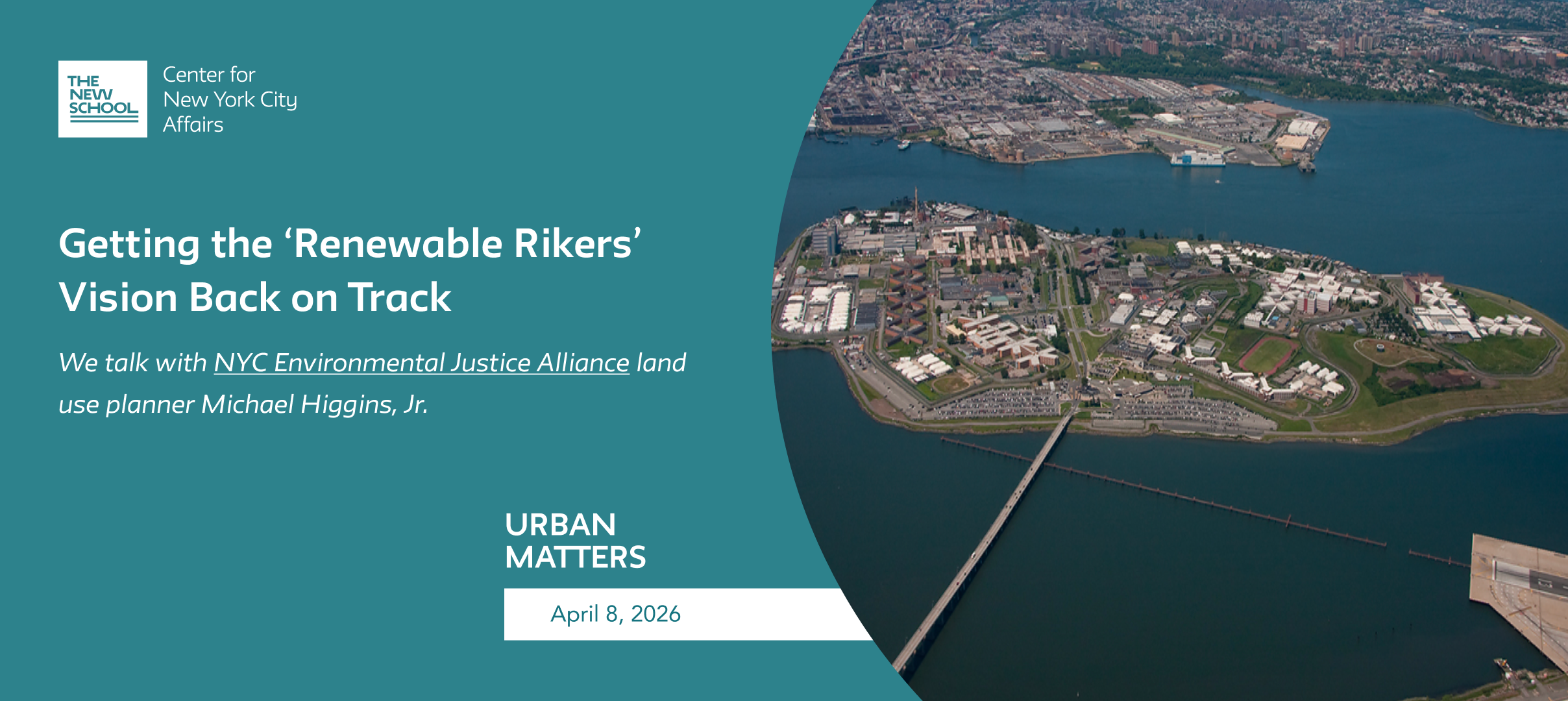
Urban Matters: Michael, you helped write the recent ‘A Reset for Renewable Rikers’ study. At the outset, explain how Renewable Rikers came about, what its goals are, and why it needs a reset.
Michael Higgins, Jr.: The Renewable Rikers campaign started as a follow-up to movement during the [Mayor Bill] de Blasio administration to close [the City’s corrections facilities on] Rikers. They made a formal commitment in 2017 to close the jails on the island in 10 years. That was legislated in the City Council in 2019 as the borough-based jail plan. [Editor’s note: The intended borough-based replacement jails are now expected to open between 2029 and 2032.]
Then the question was: What do we do with the island? The Renewable Rikers campaign brought together criminal justice advocates supportive of closing the jails with advocates aware of the environmental burdens on many of the communities around Rikers Island.
And there was a light bulb moment: a lot of communities of folks that have come to Rikers and a lot of communities that have been burdened by pollution and the siting of City facilities are the same communities, particularly when we're talking about the South Bronx.
Renewable Rikers was this vision: Can we use these 400 acres in a useful way, thinking about restorative justice, closing this chapter of incarceration in a way that’s a benefit to the city?
UM: And the upshot was the City’s Renewable Rikers Act?
Higgins: Right, it was passed by the Council in 2021, and it did several things. It created a process that the City would, every six months or so, analyze land on the island that could be removed from jurisdiction of the Department of Corrections [ DOC], and transferred to DCAS, the Department of Citywide Administrative Services. It created the Rikers Island Advisory Committee of experts and formerly incarcerated city residents to support the plan to close Rikers.
It also required the City to study the potential for renewable energy, for a new wastewater treatment plant, and for composting organic waste to be sited on the island. It came out in 2024, in two parts.
UM: That was during the [Mayor Eric] Adams administration. Other than that, what progress has there been in making Renewable Rikers a reality?
Higgins: I would say very little. And our new report was intended to say: ‘Look, this is still possible, but if we want to get it done, we need to start seriously moving on it.’
Unfortunately, even though Mayor Adams ran on general support for closing Rikers, he was hostile to actually implementing it. He missed every deadline during his administration to transfer land – eight of them, twice every year. Also, it took about a year and a half for the advisory committee to actually meet for the first time.
UM: Not to put words in your mouth, but Adams slow-walked changing Rikers, right?
Higgins: You could see that, not just on the Renewable Rikers side, but also in the increase of detainees on the island. In the beginning of 2022, there were a little over 4,000. Last month, it was above 7,000.
UM: Now we have a new administration. Have there been conversations with candidate Mamdani, Mayor Mamdani, or people close to him, saying: ‘This is City policy. It's supposed to happen.’ Are they on board and doing anything about it?
Higgins: We have seen some movement in the right direction. For example, Stanley Richards, who was a member of the Rikers Island Advisory Committee, is now heading DOC. We need multiple people in the administration that are bought into the vision and can play a role shepherding this thing.
Dring the campaign, [Mamdani] was generally supportive of closure of the jails on Rikers. We hope that continues. The mayor is also big on affordability, one of the things he ran on and won on. Renewable Rikers could save the city billions of dollars. And there are steps he can take to move things in the right direction relatively quickly.
One would be transfer of land on Rikers Island; there hasn't been a transfer in over four years. And we can't do anything in terms of this vision if we don't have land we control.
Another thing is for the City to invest funding and capacity in a master plan for Rikers Island., Without a master plan, it's hard to unlock capital funding to actually get things started.
To that point, the [Renewable Rikers] campaign has been supportive of a Council bill basically saying: Do some studies, figure out how to make this work in terms of timelines and budget, and give DEP [the Department of Environmental Protection] and DCAS the ability to work on it.
UM: Let’s go into the plan components, starting with solar capacity and renewable energy storage.
Higgins: By no means is [the solar component] going to power the city, push down energy prices, or something like that. It’s probably going to be enough to potentially power stuff on the island. But if we can connect Rikers to an offshore wind project, we're looking at close to 200 times the power that can be generated by solar.
Unfortunately, because of where the federal government is in terms of offshore wind, that's not viable right now. But in 10, 20 years, that’s going to be, I think, the big value. And the report goes into quantifying that.
UM: Now about a compost facility on Rikers. What would be the potential there?
Higgins: Right now, our largest compost facility is on Staten Island, at Fresh Kills. Rikers Island is more centrally located, and the planned facility would be close to 30 acres, more composting space than we have now. As the city more actively engages in composting [through curbside residential organic waste pickups] that can do a lot to handle the city's compost.
UM: And the wastewater treatment plant?
Higgins: It’s a big part of the vision, and could save the City billions of dollars.
Right now, there are four plants around Rikers Island. They're between 70 and 90 years old. Realistically, they're on their last legs. I wouldn’t be surprised if an accident or something else pushed forward the need to replace them. Also, the water around Rikers is some of the most polluted in the city and the country.
The capacity of the new [plant] on Rikers would be the same as the four old ones combined. They can be basically replaced gallon-for-gallon by a new facility on Rikers.
One of those wastewater treatment plants is in Hunts Point. Think: What would it look like in Hunts Point, a neighborhood short of park space, if we could shrink the footprint of that plant and give it back to the community for recreation, or something else the community could decide on?
UM: Ok, what about timelines and costs?
Higgins: The number floated in the City's feasibility studies was $34 billion. That’s a lot of money. But within our vision of the wastewater treatment plant, we can co-locate things. We can have solar panels on its roof, and co-locate space for composting.
This is going to have a 35-year timeline, conservatively. We will need the partnership of multiple administrations, multiple [City] Councils. The current administration can run the first leg of it. If approvals are done quicker, when you shorten the timeline, you shorten the cost.
We also have to recognize: Rikers Island is an island. Look at projections for sea level rise. We have a certain amount of land on the island now; come 2060, we might have a lot less. We have to think about infrastructure differently, build in resilience, and think of this not only as a vision for something better for Rikers Island, but as a model for how we do big infrastructure.
Michael Higgins, Jr., is a land use planner at the New York City Environmental Justice Alliance. He authored parts of “A Reset for Renewable Rikers.”
Photo by: John