
Will a ‘Cumulative Impacts’ Law Lead to Environmental Justice? The Devil Is in the Details.
Urban Matters: Ana, three years ago, Governor Kathy Hochul signed New York State’s Environmental Justice Siting or “cumulative impacts” law. It’s intended to reverse the longstanding over-burdening of “disadvantaged communities” with landfills, waste treatment plants, and other polluting or contaminating sites.
Please bring us up to date on the law’s impact. But first: briefly tell us why and how the law came about.
Ana Baptista: Environmental Justice organizations. like WeAct for Environmental Justice, were instrumental in pushing for the passage of this law. Around the country and not just in New York, the need for laws that address cumulative burdens in low-income communities and communities of color has been a longstanding demand of the environmental justice movement. In 2020, New Jersey was the first state in the country to pass a law requiring that permits for additional pollution be denied if a community is already experiencing too much pollution. Other states, including New York, followed suit.
UM: Just to follow up: What’s an example of cumulative impacts on a New York City community and the effects on residents’ health and safety?
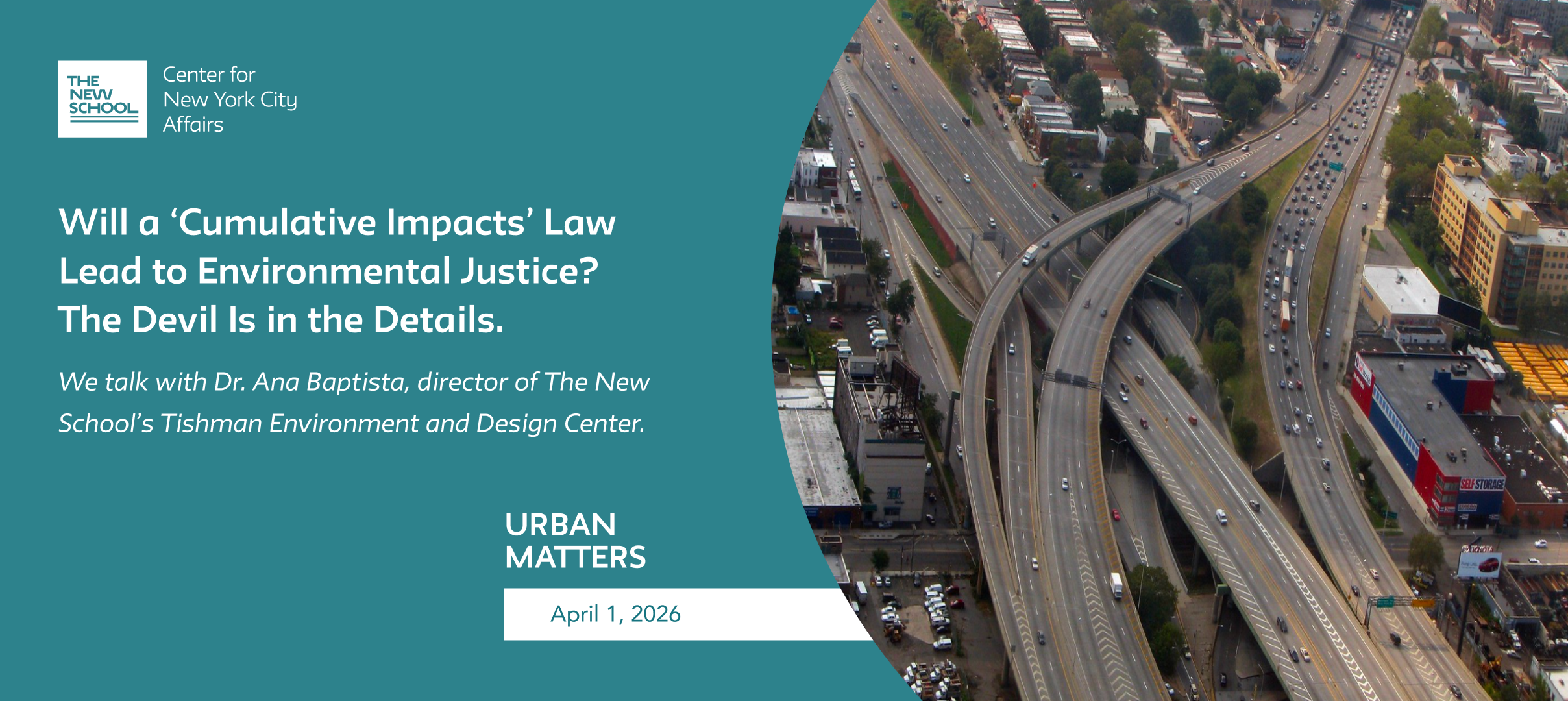
Baptista: Take the South Bronx, where communities are circled by highways [including the Bruckner and Cross-Bronx Expressways, pictured above] and living at the fenceline of multiple sources of pollution, including waste facilities, power plants, warehouses that bring significant truck traffic, and other industrial infrastructure. The cumulative pollution contributes to ongoing health impacts such as respiratory and cardiovascular illness, resulting in higher rates of health issues like asthma and related school absences.
UM: Ok, so in layperson’s language, how is the law supposed to change those conditions?
Baptista: If it works as intended, New York’s law will require authorities to stop allowing pollution to come in, or even continue, in communities experiencing more than their ‘fair share’ of burdens. For example, if a new power plant or waste facility were to propose siting in a disadvantaged community like the South Bronx, they would be required to prepare an ‘existing burden report’ which would detail: relevant baseline data on existing burdens, the environmental or public health stressors already borne by the community, the potential or projected contribution of the proposed action to existing pollution burdens, and also any benefits of the project to the community, such as increasing the housing supply, or alleviating existing pollution burdens.
If the report showed there would be a contribution to the existing burdens, the agency would be required to deny the permit. Over time, such decisions would send a signal to polluting industries that disadvantaged communities would no longer be a dumping ground for harmful activities.
UM: The way you’re describing it, it sounds like, even three years after passage, exactly how the law will work is still in flux. When it comes to legislative change, the devil is often in the details of the administrative rules and procedures fleshing out and enforcing the law. Is that what’s going on here?
Baptista: The law actually has two parts. One would put cumulative impacts protections into the State’s environmental review process, and the other would put such protections into the framework of issuing permits. Both parts are still in the stage of rule-making. In other words, details of how these review processes will be carried out are still in being figured out by the New York DEC [Department of Environmental Conservation].
Some of the key parts critical to implementation still being worked out include, for example, how the State defines whether or how a project meets the threshold for preparing a burden statement – in other words, what is the precise definition of the minimum level of pollution that contributes to any disproportionate burden? And how will the State determine when to forego the burden report because it deems a project ‘would serve an essential environmental, health, or safety need of the disadvantaged community for which there is no reasonable alternative.’ These are critical details that will decide how forcefully the law will be implemented.
UM: What’s been the experience with New Jersey’s law, and what can New York learn from it?
Baptista: We have learned in New Jersey that having a state cumulative impacts policy on the books is a significant win for environmental justice communities. However, not only is the devil in the rule-making details, but also the power of the law lies in effective implementation, too, and this implementation has required a lot of vigilance by the very communities who fought for the law.
There are now quite a few examples of cases where advocates think the New Jersey Department of Environmental Protection should have gone further to require facilities that were getting permits renewed to reduce pollution. The interpretation of very detailed rules to implement the law still leaves significant discretion in the hands of regulators to interpret their ability to modify or deny permits. Advocates must stay vigilant to ensure that the law is having the intended impact, to reduce the pollution burden in already overburdened communities.
UM: What are the next steps to ensuring the law meets its goals? And given the cutbacks in federal environmental standards and enforcement actions, how important is effective state-level action?
Baptista: State-level action is extremely critical now. Even when you do have federal environmental protections in place, the state is still the entity that is largely responsible for permitting pollution and protecting environmental and public health. We still need to be watchful and engaging NY DEC to make sure that it puts out strong rules that can achieve the purpose and intent of the Environmental Justice Siting Law. With significant federal rollbacks of basic environmental protections, strong state laws are an essential first line of defense for the most disproportionately impacted communities.
Dr. Ana Baptista is an associate professor in environmental policy and sustainability management and director of the Tishman Environment and Design Center at The New School.
Photo by: Dan Macy